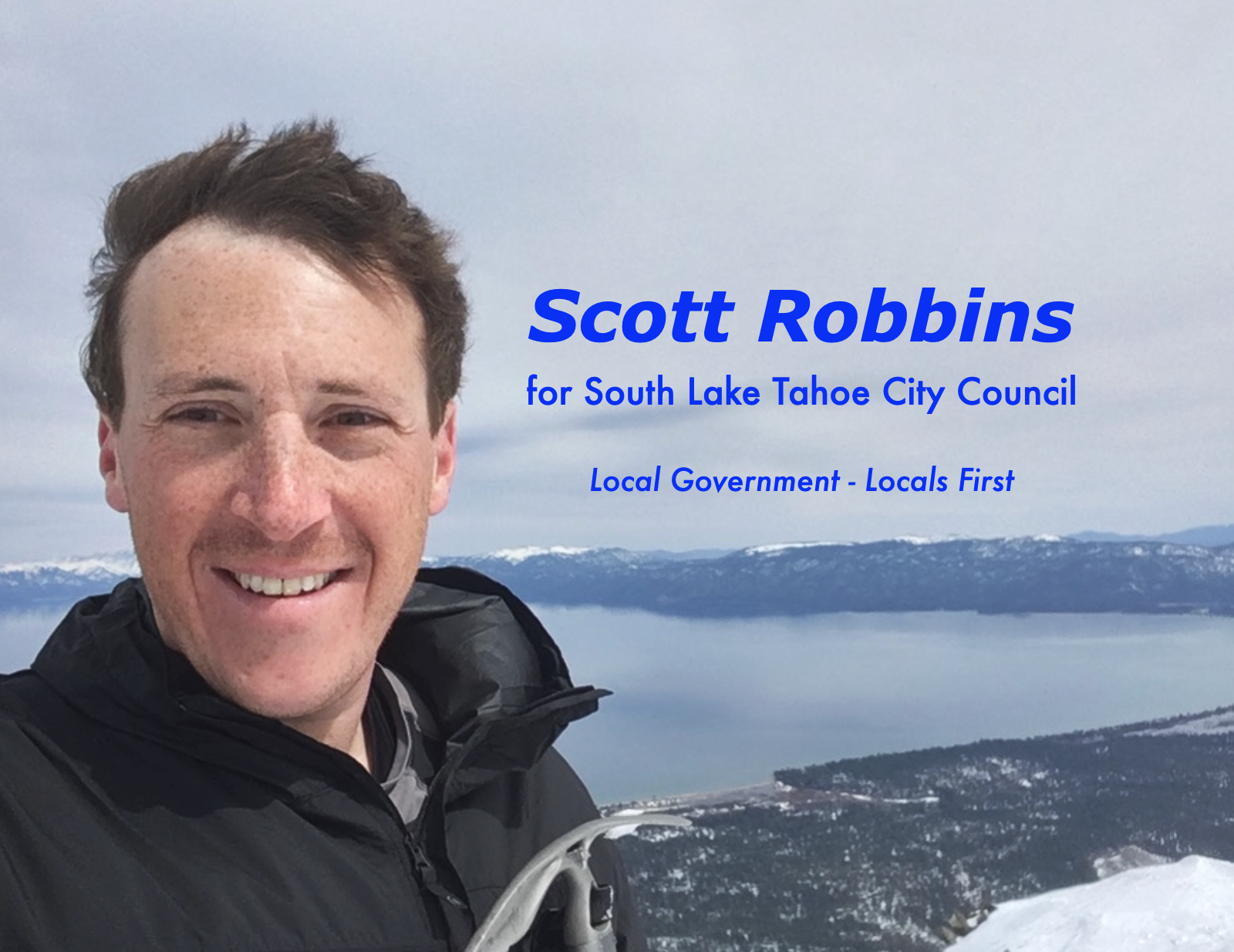
Local Issues - Local Government
I seek the office of city council to advocate for the locals. The bartenders and baristas, nurses and retirees - the people who live here, work here, and play here. Our city continues to prioritize the interests of the casinos, developers, and resorts. This must change, and it can change.
It’s the locals who make Tahoe a great place to live, not just a great place to visit.

Housing
The biggest issue the city faces is affordable workforce housing. Tahoe is bleeding locals, and the actions of the city must meet the scale of this crisis.
In my first year I passed a resolution prioritizing affordable housing for existing locals. This year I cut the administration costs of the Lease-to-Locals housing program by half saving enough money to double funding for actual grants. Unfortunately the Council also took a big step backwards by re-introducing AirBnB’s into our residential neighborhoods - which we can and should eliminate by ordinance and honor the voters intention in Measure T.
-
I will work to aggressively expand the city’s inclusionary housing funding law. This program assesses a fee on new construction to support affordable housing, but it only applies to large McMansions. Today, large AirBnB-condo developments, such as those around Heavenly Village are exempted. This can and should change.
We also need to make the development of new rental housing cost effective by amending our outdated residential zoning laws that incentivize the building of giant McMansions, but which currently outright prohibit even modestly sized duplex housing almost everywhere. Zoning changes are complex and expensive endeavors requiring environmental review and TRPA approval, meaning they must be prioritized in the city budget.
We should also expedite development of the affordable housing project at HW50 and Pioneer, and begin the long term development work for a new housing project at soon-to-be demolished fire station three (which is slated for replacement with a new fire station next door).
These efforts will need a council willing to put locals first.

Roads & Transit
In the past four years, I worked to more than double road and stormwater funding to over $6M per year. In my first year on council we cut taxpayer subsidies to the airport to zero, making the private jets pay for themselves. That funding shift alone enabled adding nearly half a million dollars per year to road maintenance.
In the last year I worked with the Tahoe Transportation District to improve bus service to 30-minute headways, and expand Lake Link service to the “Y”. I also worked with El Dorado County to provide stable funding for local bike trails, playgrounds, and ballfields.
-
Road work is now the third largest city spending item, second only to police and fire. The scale of outstanding roadwork is immense, however, with a total backlog of nearly half a billion dollars. Far too many politicians and candidates are unwilling to level with the public about the realities of the challenge, but platitudes will not fund roadworks.
We can and should raise the Transient Occupancy Tourist Tax (TOT) from the current 12% to 16% (for comparison, San Francisco is at 14%) to fund necessary road repairs
At the same time, the city collects $3 million in Tourism District funding every year - nearly all of which is spent on advertising the existence of Lake Tahoe to residents of the bay area and Texas. Significant portions of this money can and should be redirected to fund transit services along highway 50 for tourists and locals alike, especially to provide express bus services from our downtown areas to the Nevada and California beaches, and efficient shuttle services to and from Reno Airport.
We also need to make the development of new rental housing cost effective by amending our outdated residential zoning laws that incentivize the building of giant McMansions, but which currently outright prohibit even modestly sized duplex housing almost everywhere. Zoning changes are complex and expensive endeavors requiring environmental review and TRPA approval, meaning they must be prioritized in the city budget.
We should also expedite development of the affordable housing project at HW50 and Pioneer, and begin the long term development work for a new housing project at soon-to-be demolished fire station three (which is slated for replacement with a new fire station next door).
These efforts will need a council willing to put locals first.

Fire
The Caldor Fire was a warning we cannot ignore. I’ve worked over the past two years to start the funding and designing of a new Fire Station 3, that will replace the existing aging building, supporting modern full-sized fire engines. I’ve also worked to support our individual firefighters by funding additional preventative physical and mental healthcare for all of the city’s first responders.
Our biggest local threat comes from overgrown fuels and insufficient defensible space on private residential property. Many owners, often elderly, cannot afford thinning services and most grant programs are designated for government only. This creates a gap that can and should be filled with funding from the region's largest resorts and tourist operations, who have the most to lose in the event of another wildfire.

Our Environment
The imminent use of glyphosate pesticides in our forest lands is the most immediate environmental crisis facing our community. This September I was the only city council candidate or council member who showed up to comment against these pesticides at the 8/26 TRPA meeting where the issue was considered (the TRPA, notably, took no action).
The city government will be meeting in October to consider taking independent action on this issue - we must be willing to act, even when regional governments fail.
-
The exploitation of our environment from relentless over-tourism is visible everywhere from the overflowing trash on our beaches and trails, to the endless miles of traffic choking our air and roads.
We should encourage car-pooling and transit use by tourists with an overnight hotel parking tax, with proceeds dedicated to funding transit improvements and tourism environmental mitigation.
We cannot take our city’s talk about leadership on the problem of long-term climate change seriously, when we simultaneously encourage visor traffic that results in jams that can reach into Placerville. And a serious problem it is. We already face summers so hot and dry that Caldor-level wildfires have become the norm, not the exception, and we will soon begin to see winters too warm for consistent snow.
If we do nothing, if we cannot demonstrate leadership, if we cannot be taken seriously, then the children learning to ski in Tahoe today will be the parents of the last generation to ski in Tahoe, and our jewel in the Sierras will be lost for future generations of locals.

Tourism
Currently the city collects $3 million a year for tourism improvement, nearly all of which is wasted on advertising the existence of Lake Tahoe in the Bay Area and Texas. Our visitor economy is our primary important source of jobs, business activity, and public revenue - we must end the mismanagement of this industry.
If we want a better tourism economy, we must invest the money we already collect into a better tourism product, not waste our money on mismanaged advertising campaigns.
-
Exactly none of our tourism district revenue goes to pay workers for beach cleanup after the 4th of July, none for proper Reno airport transit service, and none for a Bay-to-Tahoe ski bus to reduce traffic in winter. This funding could be used to subsidize low-interest loans for refurbishing our aging motels, or for workforce housing, or even simple sidewalk improvements. Instead, nearly every dollar is wasted on social media advertisements in the bay area and Texas.
The next council will have the opportunity to renegotiate the tourism district agreement. The city must not re-approve that agreement without significant spending changes and public oversight.

Economic Diversification
Tourism is brittle. Service jobs tend to be low in pay, low in benefits, and low in stability - with tourism typically the first thing on hold during economic downturns. In Tahoe, these issues are magnified by unstable and unaffordable housing, where locals must compete with VHR's, ski-leases, and second home buyers.
We need diversification in our economy. Tahoe will always be a tourist destination, but that need not be the only thing we are.
-
Our city can assist in the development of diversified non-tourism business such as:
Expansion of Barton Hospital into an orthopedics center of excellence (like the Steadman Clinic in Vail), bringing in fellowships and patients from around the world.
Expansion of wilderness guiding and education programs through LTCC and attracting schools such as NOLS.
Improving wired internet reliability, supporting businesses which operate locally, and serve clients remotely.
Expanding non-tourism business also helps our service sector, enlarging a customer base that lives, buys, and shops here year-round. Tahoe will always be a tourist destination, but that need not be the only thing we are.

Fire Liberty Utilities
Liberty Utilities should be fired and replaced with a local, publicly owned, non-profit electric utility district.
Liberty has failed in their responsibility to deliver reliable electricity at fair prices. They prioritized profits for shareholders over investing in undergrounding power lines for fire risk reduction and reliability against downed trees during storms. What’s more, despite this disinvestment, Liberty has dramatically hiked rates, leaving us with expensive and unreliable power.
We do not have to tolerate this. There is an alternative.
Residents in Truckee are not served by Liberty, but by the local, publicly-owned Truckee-Donner Public Utility District, a non-profit whose leaders are elected by the public. With no private investors demanding profits, a publicly-owned utility’s only interest is to deliver the most reliable power at the lowest price.
-
The process to create a public utility is not easy, but it’s worth the effort. The city would work to create the district legal entity, defining the region covered and a financial plan to assume services. The residents would then vote to approve or reject that plan to replace Liberty. If approved, the district would issue a bond (i.e., take out a loan) to be repaid by the sale of electricity in the future. The money raised would be used to buy out Liberty's infrastructure within the district by eminent domain. The public would then elect the new districts governing board, and in turn, approve rates for homes vs tourist resorts, choose between renewable vs. fossil fuels, how much solar we can generate locally on our roofs and sell back to our grid, how much investment we want to make in reliability improvements, and how much to invest in local energy storage.
The potential for improvement to our power grid is not hypothetical. Our water utility, STPUD, recently completed a 1 MW solar generation facility on their property that powers much of their own plant operations. Their original plan however, was to build a 3 MW facility, and sell the extra 2 MW back onto the local grid. Liberty however, not wanting competition with their own power generation, and not wanting to be bothered with the investments needed to handle distributed generation, refused. We lost out on 2 MW of locally generated clean energy because of a for-profit monopoly's corporate greed.
Four years ago, as part of the 2022 strategic planI, I proposed that the City of South Lake Tahoe establish a public electric utility. After only a brief, preliminary investigation however, the majority decided it was not worth the effort, and that there was a risk that electric rates might rise. Instead of firing Liberty, the council chose the lesser option of pursuing a “community choice aggregator”, a legal construct which allows the city some influence over generation sources, but which in no way addresses Liberty's disinvestment in reliability, their rates, or the amount they profit off our backs. It was better than doing nothing, but not good enough.
Rates rose anyway. And in exchange for those higher prices, we locals got nothing. No improvements to reliability, no improvements in sustainability, just a higher bill.
Most recently, Liberty failed to secure adequate long-term supply contracts from regional generators who have now abandoned power delivery to humans, in favor of AI datacenters in Reno and Sparks. Now Liberty is scrambling to buy power from as far away as Utah and Oregon, at far higher prices, and passing those costs on to us (notably having lost out on 2MW of generation from the original STPUD project they blocked).
The next city council will have a choice to either leave the public stuck with Liberty, or do the hard work to replace them and allow us to control our own future.
If re-elected, I will continue to advocate for locals - and that includes keeping our lights on.
The time has come to fire liberty.

No New Sales Taxes
Two sales taxes are ahead for South Lake Tahoe Locals. El Dorado County has placed measure Measure S, a new county-wide sales tax on the ballot. A new city sales tax is also quietly being developed by business and tourism leaders in the community. This city sales tax would be in the form of a new “business improvement district” that would apply a tax to all retail sales in the city, with the ostensible purpose of funding transit. The money collected however, would be controlled exclusively by private for-profit corporations, with no control by any elected government.
Sales taxes are regressive. They tax locals over tourists. They hurt the working class far more than the wealthy. I opposed Measure G, the sales tax from four years ago (about which the city lied, calling it a 1¢ tax, when it was in reality a 1% tax), and I oppose Measure S for the same reasons.
-
While Measure S is subject to a citizens vote, here In California, business district taxes (the form of sales tax being considered for the city) are not. Business district taxes can be passed by a simple majority of the city council, and then by a majority of business owners, with their votes weighed by their revenue (one vote per dollar). Sales taxes imposed by business districts are not only regressive, they are anti-democratic.
I support funding transit, but this city already collects $3M per year for the “tourism improvement district”. This funding can be used to support transit. However, nearly all of the money we collect is wasted on social media videos advertising the existence of Lake Tahoe to residents of the Bay Area and Texas. This is the money that should be used, not a new tax on locals.
The next council will make this decision.
My position is clear: No New Sales Taxes.

About Scott Robbins
Six years ago I prioritized my passion for the mountains and left the East Coast behind. After my first summer here, I started volunteering my time as a way to give back to this community.
I’ve worked with Tahoe Neighborhoods Group to pass Measure T, which eliminated vacation rentals in residential neighborhoods. I volunteer with the El Dorado County Economic Development Advisory Committee, and the South Tahoe Bicycle Advisory Committee.
I’ve advocated extensively in opposition to the Loop Road, which would demolish the Rocky Point neighborhood, and displace local families, all to better speed tourists to the Nevada casinos.
I have regularly engaged with the City Council and written on a wide range of local issues including over-tourism, and for reforming police protocols for handling of sexual assault victims.
I believe very strongly in the value of community and in volunteering to give back to this place which has given so much. It is the locals that are the heart and soul of this place we call home.